
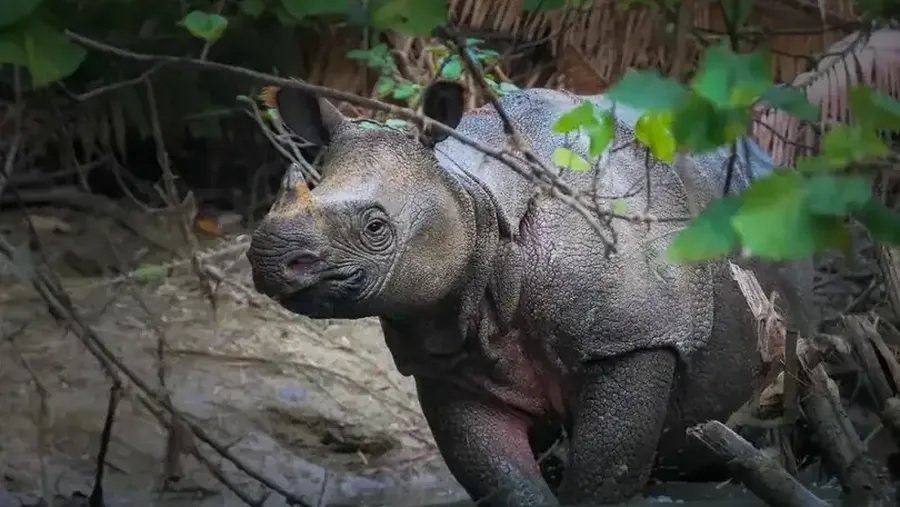
en.Sketsamalang.com – Deep within the forests of Ujung Kulon National Park on the western tip of Java, Indonesia, the world’s last wild population of Javan rhinos continues to survive. Camera-trap surveys in 2026 estimated the population at between 74 and 99 animals, with a best estimate of 91. All wild Javan rhinos are confined to this single habitat in Indonesia, leaving the critically endangered species vulnerable to threats affecting the entire area.
In mid-November 2026, discussions about establishing a second habitat for the species gained renewed attention after Hashim Djojohadikusumo, the President’s Special Envoy for Climate and Energy, raised the idea during the COP31 climate conference in Antalya, Türkiye. He highlighted the risks of keeping the entire population in one location, particularly in the event of a major natural disaster.
“If there is a tsunami caused by an earthquake or a volcanic eruption, the Javan rhinos could become extinct. That is why there is an idea to move a number of them to Alas Purwo,” Hashim said, as reported by Indonesian media outlets covering the event.
The concerns are rooted in geography. Ujung Kulon lies near the Sunda Strait, an area exposed to seismic and volcanic activity, including the presence of Anak Krakatau. A major tsunami could potentially devastate the rhinos’ only remaining wild habitat. Genetic concerns also add to the challenges, as the isolated population faces limited genetic diversity and the risk of inbreeding.
However, the proposal remains under consideration, with government officials emphasizing that conservation decisions must be guided by scientific research rather than urgency alone. Forestry Minister Raja Juli Antoni has reiterated that Ujung Kulon will remain the primary habitat for Javan rhinos.
“The relocation plan is still under review, and the rhinos will never be relocated without scientific recommendations from scientists,” Raja Juli Antoni said, as reported by Kompas.com.
He also stressed that the process would require further research, with no immediate urgency to move the animals. “The process is still ongoing, and it is unclear when a decision might be made. There may not be an urgent need to relocate them for now, as the matter requires in-depth research first,” he said.
A similar position was expressed by Muhamad Hidayat, a senior expert at the Government Communications Agency. He said Alas Purwo National Park in East Java could only be considered as a second habitat if its ecological conditions and security were proven suitable through comprehensive scientific assessments.
“Ujung Kulon remains the primary home of the Javan rhino and must continue to be protected. Alas Purwo can only be considered a second habitat if all ecological and safety requirements are proven through scientific studies. Without that, the relocation will not be carried out,” Hidayat stated on November 17, 2026, as reported by CNN Indonesia and Detik.
On November 25, the head of the Government Communications Agency, Syahganda Nainggolan, also addressed circulating claims that Javan rhinos had already been secretly moved. He dismissed the reports, confirming that no relocation had taken place.
“I can conclude that up to now there has been no relocation of the rhinos,” he said, according to Antara.
Read Also:
Indonesia Releases Two Rescued Orangutans into the Wild in West Kalimantan
Local authorities have also voiced concerns about the risks of moving the animals, pointing to the death of a male rhino named Musofa in November 2025. Musofa had been transferred to the Javan Rhino Study and Conservation Area (JRSCA), a conservation facility within Ujung Kulon National Park, as part of an internal conservation effort. He died two days after arriving, at an estimated age of more than 45 years, from chronic health conditions that had existed before the transfer.
“We remember the case of Musofa. We do not want to see more cases like that,” Banten Governor Andra Soni said, as quoted by Kompas and Antara.
Following Musofa’s death, conservation teams revised their procedures for internal translocations within Ujung Kulon. Candidate animals are now restricted to individuals between six and 25 years old whose ages can be verified through long-term camera-trap records. Health assessments, animal selection and quarantine procedures have also been strengthened to reduce risks during the process.
As of November 26, 2026, no Javan rhinos have been relocated outside Ujung Kulon National Park. The proposal to establish a second population remains under scientific evaluation, while conservation authorities continue to prioritize habitat protection, population monitoring and efforts to safeguard the species in its existing home.
1 comment